
Thijs Biersteker x Natural History Museum
Econario
A robotic plant that shows how our political choices today, impact biodiversity tomorrow.
INTRODUCTION
Econario is a data-driven artwork that turns the invisible trajectories of biodiversity into something tangible.
The robotic plant responds to real scientific models, transforming distant ecological futures into a present, embodied experience.
At the heart of Econario lies a simple but powerful idea: political and socioeconomic choices are not abstract. They shape the living systems that sustain us, and we shape them. By translating future biodiversity scenarios into a living structure, the work invites visitors to reflect not only on what is happening to nature, but on their own role within these unfolding futures.

CREDITS
Artistic Lead
Thijs Biersteker
Scientific Lead
Prof Andy Purvis and Dr Adriana De Palma
Studio Director
Sophie de Krom
Technical Engineer
Tom Bekkers

THE EXPERIENCE
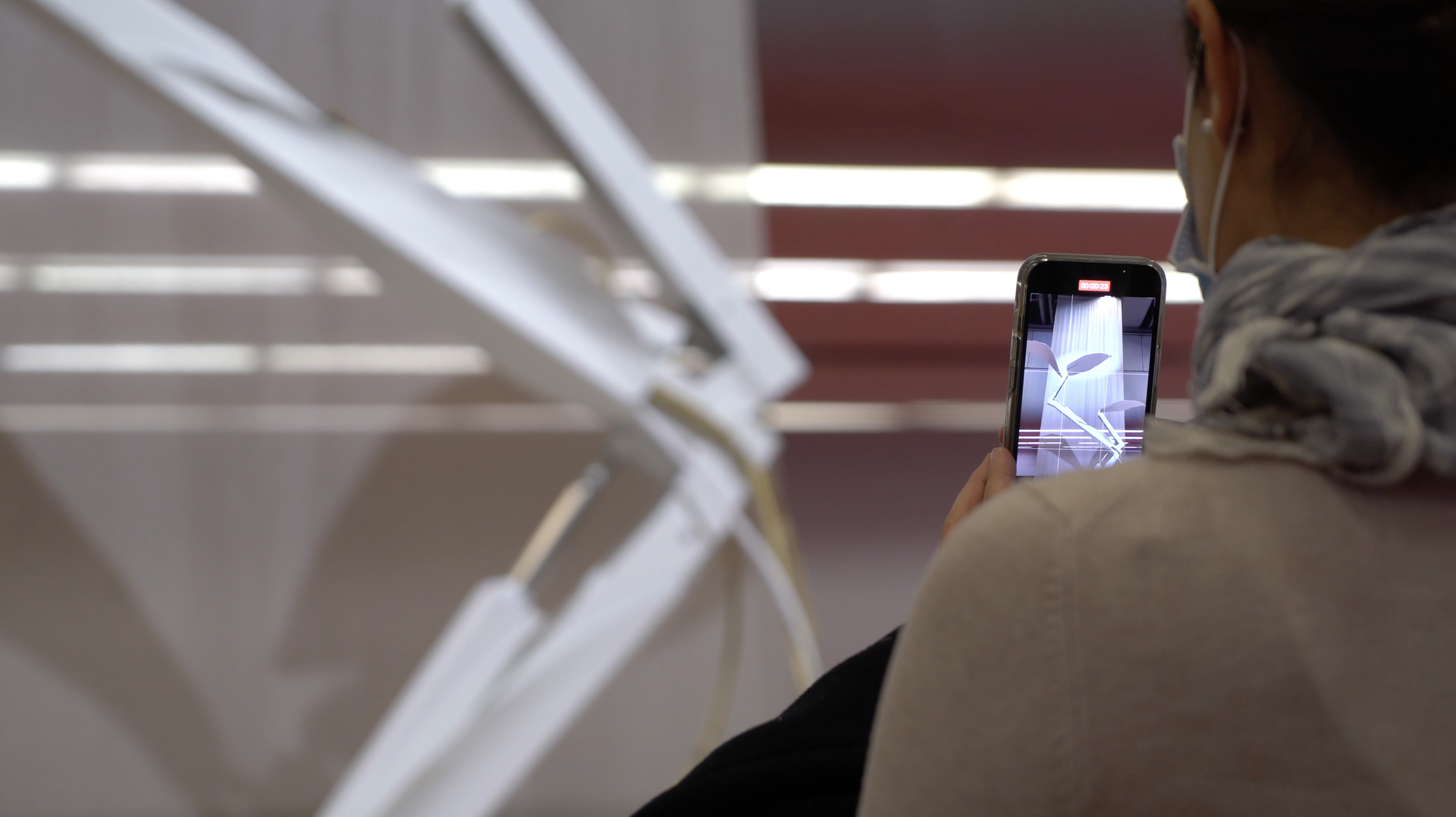
Visitors encounter a 5-metre robotic plant that grows or declines based on biodiversity data: when the data projects decline, the structure folds into a rigid, mechanical form; when the projections improve, it opens and stretches upward in a more plant-like, organic movement. At times folded tightly, at times opening into a full, upright form, its movements reflect biodiversity projections for the location in which it is exhibited, from global scenarios to local models.
As scenarios shift, from sustainable policy choices to fossil-fuel-heavy futures, the plant either flourishes or withers. The more hopeful the scenario, the more open and plant-like the structure becomes; the more damaging the projected policy pathway, the more the structure collapses into its rigid core.
Visitors witness the consequences of political decisions and their agency in aligning with futures that either protect or endanger biodiversity.
Small displays show the exact scenario, location, and percentage of biodiversity growth or decline being visualised, enabling viewers to link the sculpture’s transformation directly to the data.
Econario sets out to evoke empathy, with its slow flourishing symbolizing hope and joy, and its withering provoking discomfort.

MATERIALISATION
The structure is a 5-metre robotic plant, engineered with precision and built sustainably. Its motion is powered by a kinetic engine that translates BII data into elegant, plant-like gestures.
When biodiversity predictions rise, a series of articulated segments expand and reach upward; when predictions fall, the structure contracts, mimicking the behaviour of a fragile seedling struggling to survive. Small integrated displays communicate the active scenario and location, while the structural form, part industrial, part biological, embodies the tension between human-made systems and the natural world. The entire piece is modular and recyclable, reflecting our circular design principles.
The result is a hybrid organism of mechanics and meaning: a data-driven body whose physical state mirrors the health of the ecosystems we depend upon.
IMPACT
Econario serves as a moving monument to the urgency of biodiversity loss, visualising the consequences of human decision-making.
By converting policy data into emotional, embodied experience, the artwork sets out to bridge the gap between scientific evidence and public understanding. More than a sculpture, Econario is a reminder of our agency, a reminder that biodiversity is not an abstract notion but a shared future we actively shape.
By visualising projected biodiversity intactness under different political and socioeconomic pathways, the work brings global scenarios into a personal encounter. Small displays show the exact scenario, location, and percentage of biodiversity growth or decline, enabling viewers to directly connect the sculpture’s behaviour to the underlying data.
Through this tangible data embodiment, Econario strengthens the public’s awareness of biodiversity loss and supports a clearer sense of agency in choosing more sustainable pathways. Ultimately, Econario asks a simple but profound question: What world will grow from the choices we make today?

Technical Build
Bastiaan Kennedy, Sander van Gelder
Technical Development
Jochem Esser, JBS Technics
Frontend developer
Bas van Oerle
With special thanks to
The Natural History Museum London, Sara Contu, Kunstkerk Dordrecht, Boris Gunst, Nathan Pottier, Madelief Broekman

“Even with all the data we have, it’s still hard to imagine what the future might look like. ‘Econario’ makes that future visible. Using BII data, we can glimpse the worlds we’re creating, and perhaps find a small spark of hope if we choose the right path.”

| EXHIBITIONS |
| Dutch Design Week (NL), 2025 |
| COP15 Montreal (CA), 2023 |
| G20 Exhibition India (IN), 2023 |
| World Government Summit Dubai (UAE), 2023 |
| Kunstkerk Dordrecht (NL), 2022 |
SCIENCE
Econario is built on one of the world’s most comprehensive biodiversity models: the Biodiversity Intactness Index (BII) developed by the Natural History Museum London.
The BII draws from 4.7 million ecological records across species, habitats, and human-impact data to model how ecosystems will look in 2050 under different political and socioeconomic scenarios.
These scenarios, ranging from sustainable pathways to fossil-fuel-intensive futures, shape the real-time behaviour of the artwork. The robotic structure grows or declines according to projected biodiversity intactness, translating complex models into intuitive, physical motion.
The science behind the work is led by biodiversity researchers Prof. Andy Purvis and Dr. Adriana De Palma, whose research focuses on understanding ecosystem resilience, species abundance, and the systemic drivers of biodiversity loss.
By grounding its motion in real scientific predictions, Econario transforms abstract, complex data into an embodied experience, revealing how today’s political choices ripple into the ecological realities of tomorrow.

Credits film/photography
Director: Jerom Fischer
DP: Thomas Fibbe
AC: Harvey Pieper
Grading: Jan Maarten de Wit
Sound: End of Time
Photography: Thijs Biersteker, Jerome Fischer, Cas Kerrsens