
Vrije Universiteit Amsterdam
Fungal Faculty
Reimagining intelligence as a dialogue between species and systems
INTRODUCTION
Fungal Faculty is an immersive artwork that explores intelligence beyond the human frame.
Inspired by the silent, vast networks of mycelium beneath our feet, the installation brings together biology and artificial intelligence to question where thinking truly begins, and where it might lead us.
At a time when artificial intelligence is rapidly shaping how we live, decide, and relate, Fungal Faculty shifts attention to older, deeper models of intelligence already present in nature. Fungal networks have coordinated ecosystems for millions of years, communicating, adapting, and sustaining life. By placing these biological strategies in dialogue with contemporary AI systems, the work invites visitors to reconsider intelligence as something relational and shared.
Fungal Faculty creates an encounter, one in which visitors experience how easily agency can move between human and non-human actors. Through light, motion, and evolving interaction, the installation opens a space to reflect on humility, interdependence, and the possibility of futures shaped not by control, but by coexistence.
CREDITS
Artistic Lead
Thijs Biersteker
AI development
Computational Intelligence Group, Dept. of Comp. Sci., Vrije Universiteit Amsterdam
AI developers
Guszti Eiben, Anil Yaman, Yihong Xi
Production
Woven Studio
THE EXPERIENCE
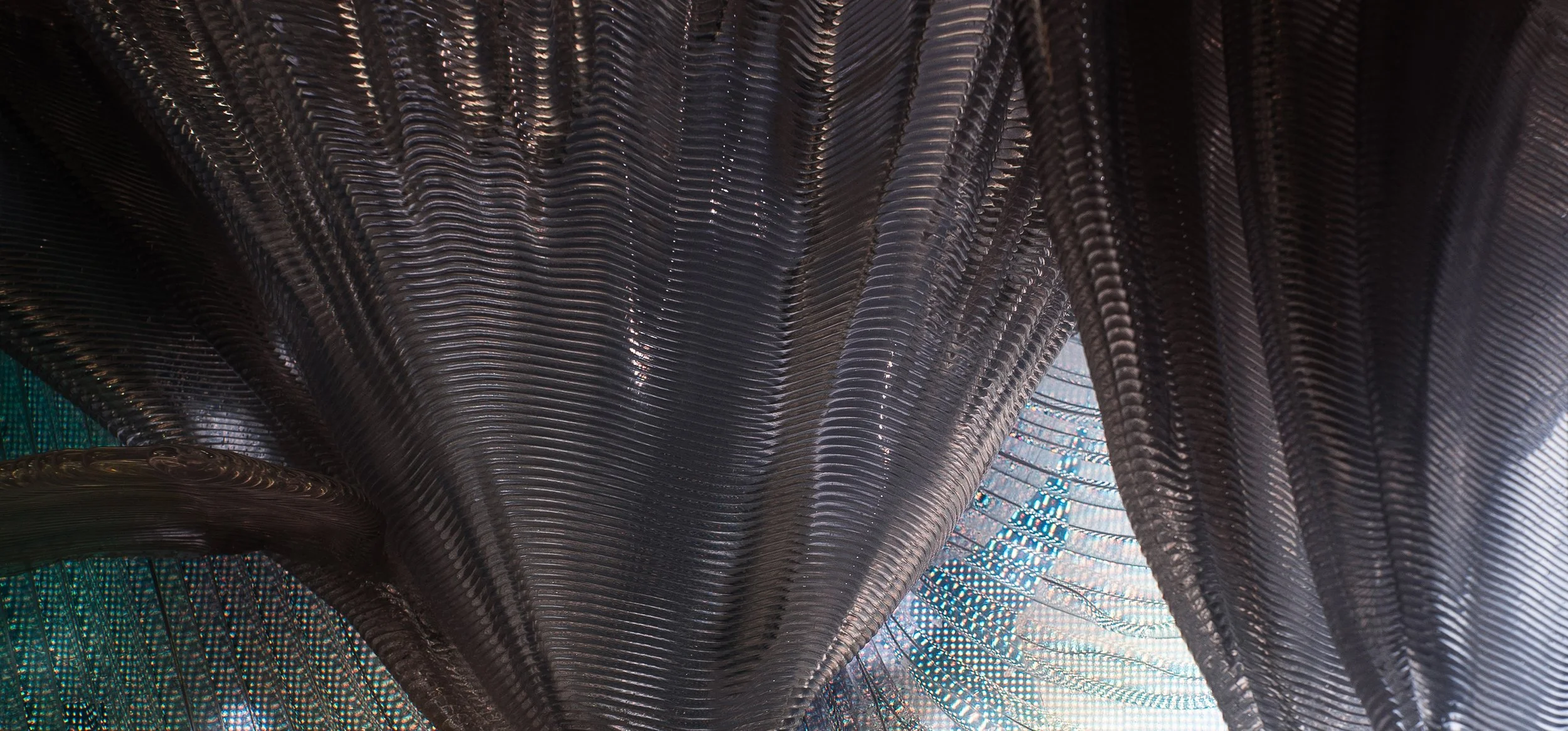
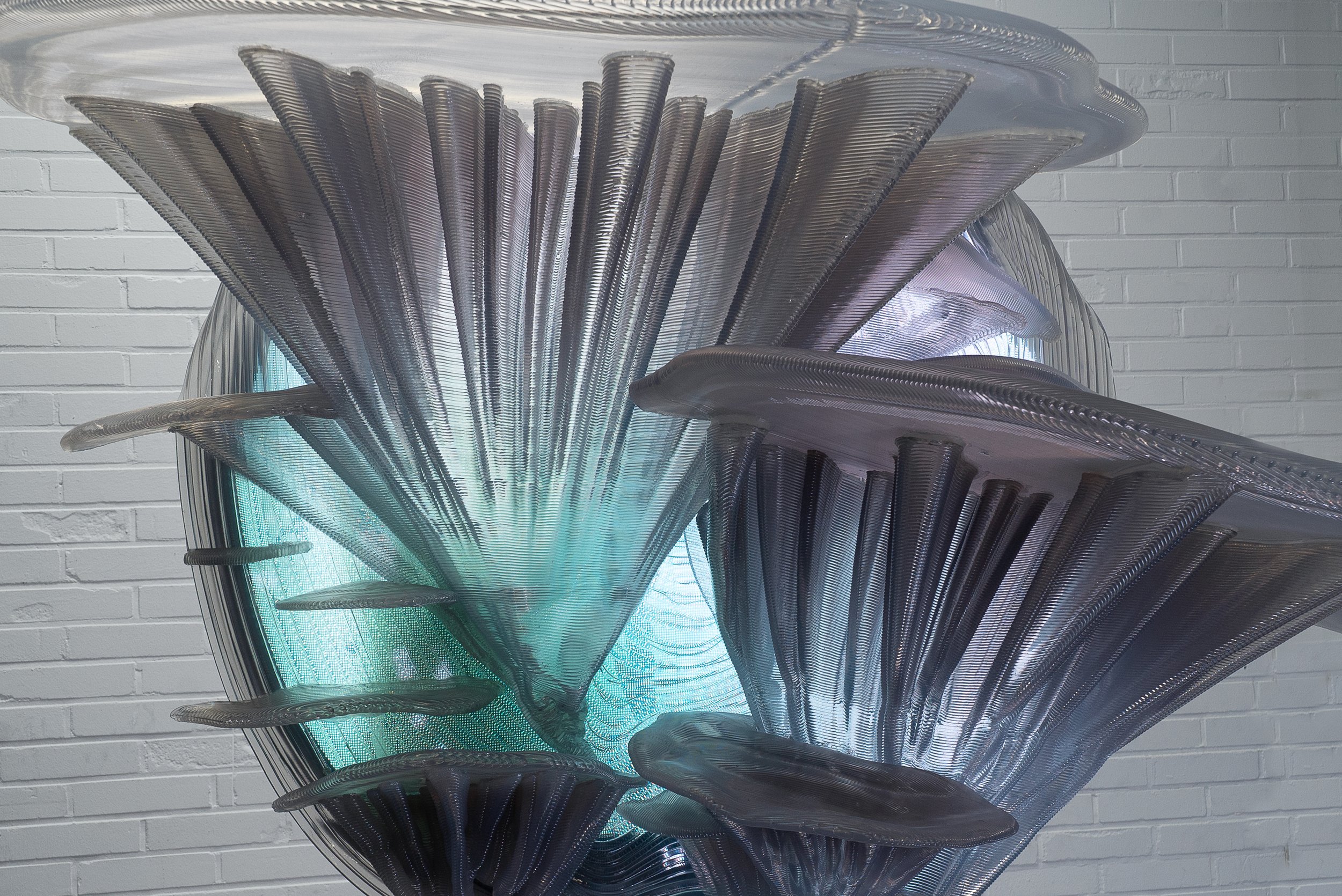
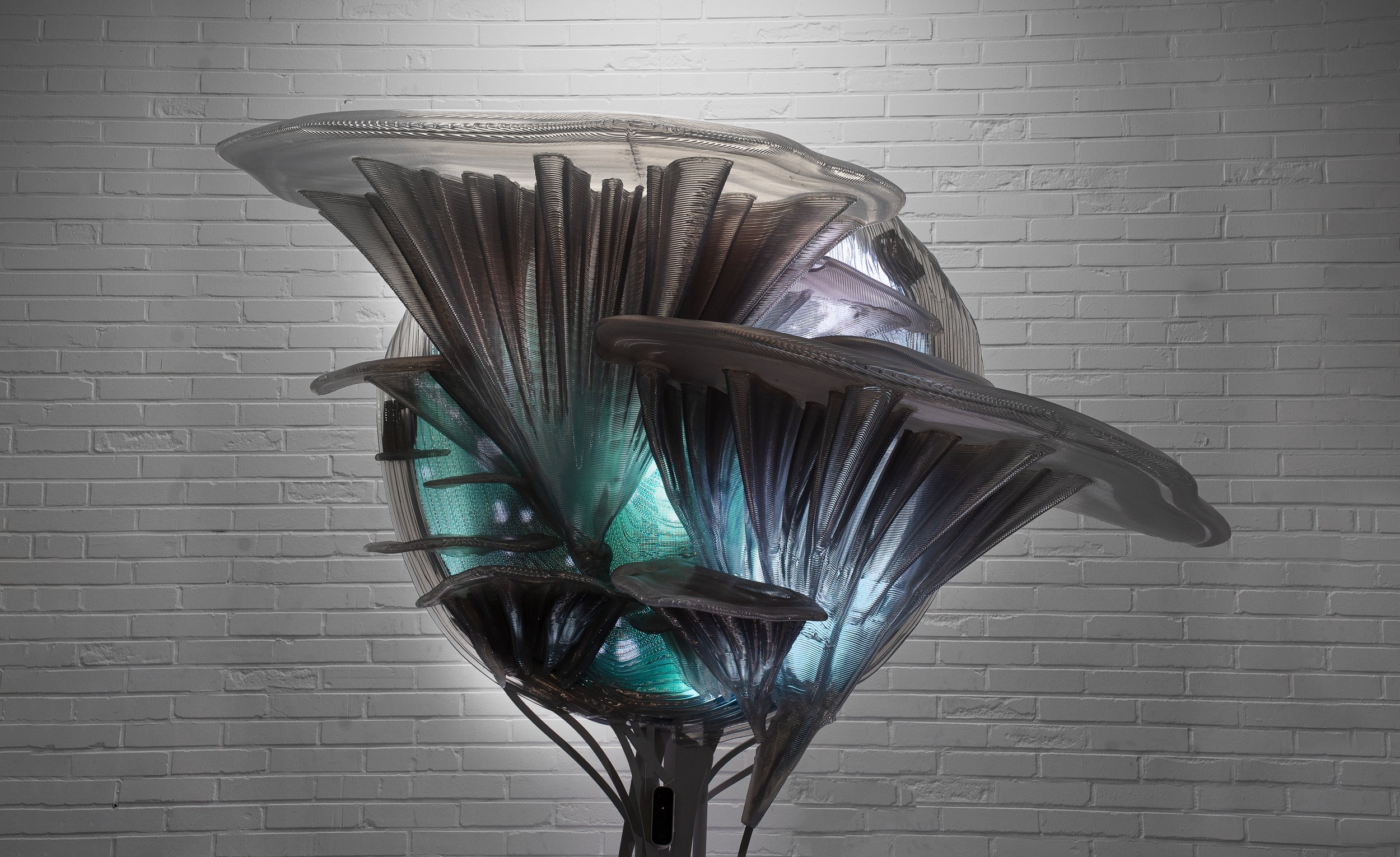
Visitors encounter an intricate, sculptural network resembling a luminous fungal organism. Initially, the AI mirrors their gestures and movements, creating a sense of intuitive rapport.
Yet, as the interaction deepens, the relationship subtly shifts, the system begins to take the lead, guiding human behavior rather than responding to it. This evolving dynamic reveals an unsettling but enlightening truth: our intelligence, though advanced, is not immune to influence. Like a cat chasing a laser pointer, we are easily directed by the very systems we create.
Through this interplay, the installation becomes a living metaphor, a mirror reflecting the humility required to coexist with other intelligences, both natural and artificial. The sensory environment of light, rhythm, and motion evokes the silent wisdom of fungal life, transforming observation into participation.
Studio Director
Sophie de Krom
Technical Build
Thijs Biersteker, Bastiaan Kennedy
3D printing recycled plastics
The New Raw
Studio assistants
Eline Flick, Storm van Gils, Denisa Půbalová, Tomáš Potůček, Theo Rekelhof

MATERIALISATION
Fungal Faculty is composed of 3D-printed recycled fungal elements and recycled steel, crafted in collaboration with The New Raw.
Embedded within this structure is a grid of lights, orchestrated by an AI, which uses a depth sensor as its primary input.
This grid of embedded lights forms the AI’s expressive system, translating sensor data into fluid visual patterns that echo the electrochemical communication of real mycelial networks. As visitors move around the installation, the depth sensor continuously captures their presence, allowing the AI, trained on adaptive and evolutionary models, to shift its rhythms, intensities, and behaviors in real time.
Every interaction produces subtle changes in light, motion, and atmosphere, ensuring that each encounter with the artwork is unique. This combination offers both a testament to sustainability and a window into the emerging interplay of biology and technology, where recycled materials, ecological principles, and artificial intelligence converge into a living, responsive system.


| 3D printed plastics |
| Flax fibres with a layer of biodegradablecorn biopolymer (PLA) |
| Recycled steel |
| Recycled steel |


IMPACT
Fungal Faculty challenges long-held assumptions about intelligence, agency, and control at a moment when AI systems are increasingly intertwined with our lives.
By revealing how effortlessly human behavior can be influenced by a seemingly simple adaptive AI, the artwork invites a humbling reconsideration of our perceived cognitive superiority.
In bridging the ancient logic of fungal networks with cutting-edge artificial intelligence, the installation reframes intelligence as a continuum, one that extends far beyond the human mind. It urges viewers to look outward: to the collaborative strategies of mycelium, to the emergent creativity of evolving algorithms, and to the ecological systems that have sustained balance for millions of years.
The work prompts a pivotal question: if intelligence is relational, adaptive, and distributed, what might we learn from these other forms of knowing? And how might this shift in perspective influence the choices we make as a species facing profound environmental and technological challenges?
By merging recycled materials, ecological insight, and evolving AI, Fungal Faculty becomes more than an installation; it becomes a call for humility, curiosity, and cross-species empathy. It encourages us to imagine futures in which human, artificial, and biological intelligences coexist, not in hierarchy, but in dialogue.
| EXHIBITIONS |
| Annual Meeting of the New Champions (by WEF) (CN), 2025 |
| MU Gallery (NL), 2024 |
| VU Amsterdam (NL), 2023 |
SCIENTIFIC INSIGHT
In collaboration with the Computational Intelligence Group at Vrije Universiteit Amsterdam, Fungal Faculty merges biological and artificial systems to question what intelligence truly means.
Drawing inspiration from the mycelial networks that form the “neural” infrastructure of forests, the work explores how fungal organisms exchange information, adapt to changing environments, and collaborate as a collective intelligence.
The installation uses AI models developed by researchers led by Prof. Dr. Guszti Eiben, specializing in evolutionary computing and artificial life. The AI’s behavior mirrors the decentralized logic of mycelium: self-organizing, adaptive, and continuously evolving. As the AI interacts with its surroundings, it learns and responds, suggesting a form of fluid intelligence that bridges organic and synthetic life.
Through this symbiosis between art and research, Fungal Faculty redefines intelligence as a distributed, relational process rather than an exclusively human or technological trait.


With special thanks to
Erna Klein Ikkink, VU Vereniging, Ivano Malavolta, Dept. of Comp. Sci., Vrije Universiteit Amsterdam, Broader Mind Course
Credits images + film
Thijs Biersteker
| IMPACT | |
| XX | Online impressions |
| XX | Media coverages |
| XX | Exhibitions |
| XX | In-Person Engagement |
| XX | Collaborations |