
Cultuurmakersfonds
MBCO2
Uncovering the hidden impact of the internet.
INTRODUCTION
Digital activity feels weightless, but its environmental cost is substantial.
Every message sent, video streamed, and file stored triggers energy use across global data infrastructures that remain largely invisible to the public. Because the footprint is dispersed across countless servers, cables, cooling systems, and energy grids, its impact often goes unnoticed.
MBCO₂ brings this hidden cost to the surface. By translating everyday internet behaviour into a measurable CO₂ output, the artwork reframes digital activity as a material process with real environmental consequences.
The installation uses a familiar experience, connecting online, to make tangible the scale of emissions generated by actions most people don’t recognize as environmentally significant. In doing so, MBCO₂ positions digital sustainability as an essential part of climate awareness.


SCIENTIFIC INSIGHT
Our daily data usage creates a hidden but significant CO₂ footprint, up to 20 grams of CO₂ per megabyte.
According to MIT, an average hour on Zoom produces 160g of CO₂ per person, equivalent to driving 140 meters in a petrol car. A night of streaming can emit up to 900g of CO₂, and trading a single NFT can generate tens to hundreds of kilograms of CO₂, depending on the blockchain and energy source.
Internet use accounts for 3.7% of global greenhouse gas emissions, roughly equal to the emissions of the entire aviation sector. This figure is projected to double by 2025 (excluding the impact of Covid-19).
Across all devices and networks, the internet emits approximately 1 billion tonnes of CO₂ per year. This is comparable to the annual fossil fuel consumption of Turkey or Poland, or more than half of what the UK burns in a year.
According to Gartner, data centres alone account for roughly one-quarter of the energy consumed, and the carbon emitted, by the information and communication technology (ICT) sector, amounting to around half a percent of global CO₂ emissions.

EXPERIENCE
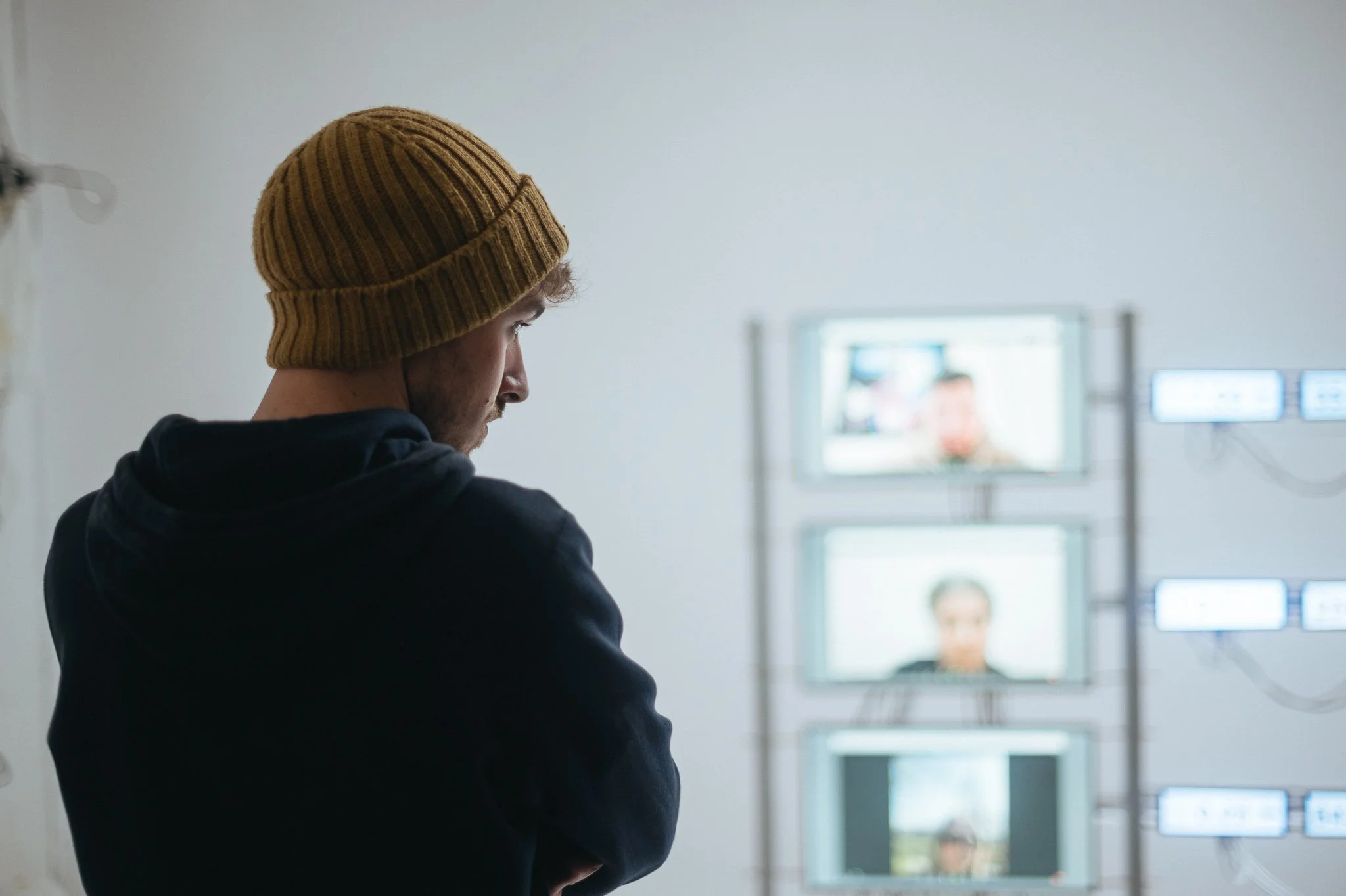
Visitors see people “Zoom” directly into the installation.
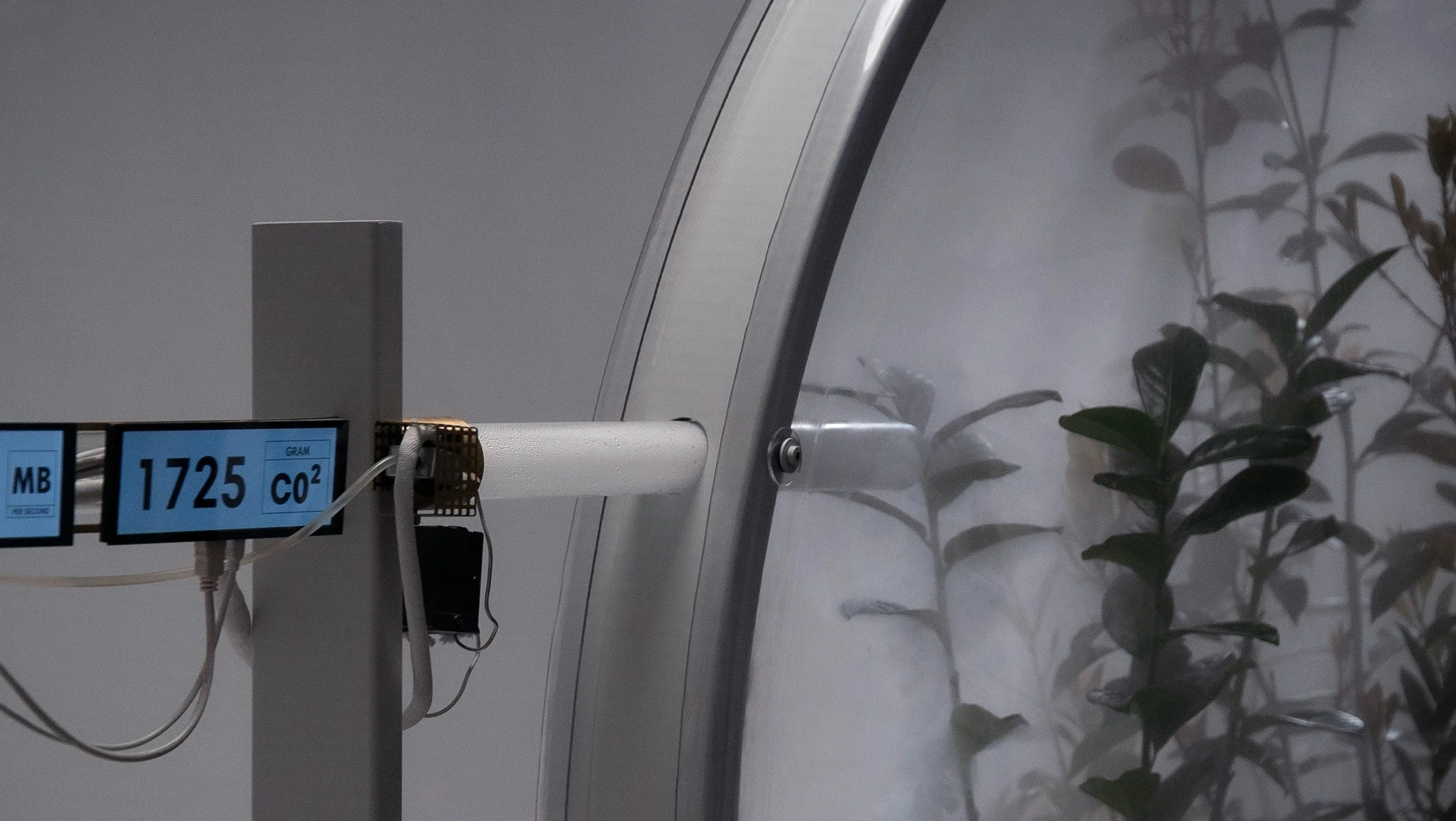
As each connection is made, the artwork tracks their data usage, calculates the associated carbon footprint, and converts it into controlled releases of CO₂- like puffs inside a planet-shaped living biotope. The impact becomes visible on a small but immediate scale.
Between the live video feeds, the installation reveals the carbon cost of actions often overlooked: the energy demanded by AI algorithms, the intensity of NFT transactions, the weight of email attachments, and the cumulative impact of streaming services.
By making data use legible as physical output, the work exposes how every megabyte generates heat inside data centres, requiring energy that is still largely produced by coal and gas.
The result is a clear, accessible encounter with digital emissions, transforming abstract statistics into an experience that is felt rather than only understood.

MATERIALISATION
The installation carries the aesthetic of a compact emission facility, edged with a subtle sense of dystopian realism.
The planet-shaped biotope is built from recycled steel and filled with living plants, creating a miniature ecosystem that responds to visitors’ digital activity. A smoke machine releases emissions based on real-time calculations of CO₂ output.
All emissions are grounded in current research:
For Zoom and video calling: 150g CO₂ per hour (MIT)
For 1MB email attachments: 20g CO₂
For Netflix streaming: 450g CO₂ per hour
As companies become more transparent about their impact, the artwork is updated to reflect new data, ensuring accuracy over time.
| Materials |
|---|
| Recycled steel |
| Living plants |
| Screens |
| Valves |
| Smoke machine |
| Software and custom emissions-calculation system |
IMPACT
MBCO₂ intends to shift public understanding of digital behaviour by revealing its environmental footprint in a way that is immediate and concrete.
By connecting familiar online actions to a physical response in the biotope, the work opens space for a more informed relationship with the infrastructures that support contemporary life.
The installation does not prescribe solutions. Instead, it provides a framework for recognition, clarifying how streaming, messaging, data storage, and algorithmic processes collectively shape global emissions. When these impacts become visible, digital sustainability becomes an accessible and actionable idea rather than an abstract concern.

CREDITS
Artistic Lead
Thijs Biersteker
Production
Woven Studio
Studio Director
Sophie de Krom
Build and engineering
Thijs Biersteker, Bastiaan Kennedy,
Creative Technology
Alice Stewart
Construction
Bastiaan Kennedy
Soundscape
End of Time & Thijs Biersteker
Studio Assistants
Theo Rekelhof, Amba Bharti, Nathan Pottier, Madelief Broekman
With special thanks to
Belén Vera-Raya
Corine Muller-Bauer, and Hein Muller
Supported by
Cultuurmakersfonds
Film and editing
Nic Kroone
Images
Thijs Biersteker
SOURCES